How Epoxy Floor Coating Improves Safety & Productivity in Automotive Service Centers
May 25, 2026
Industrial Flooring for Food Plants: USDA Compliance Checklist
June 8, 2026
2026 ESD Flooring Requirements & Best Practices
Electronics and robotics manufacturing facilities face tight quality standards and high performance expectations in 2026. A single uncontrolled spark is all it takes to damage sensitive components, disrupt production, and damage your reputation.
Flooring plays a big part in controlling these risks. An effective ESD floor gives static electricity a safe, predictable path to ground, protecting your equipment, products, and people in the process. If you operate a manufacturing facility in 2026, it’s important to understand how ESD conductive flooring systems work so you can choose a solution that holds up under real-world conditions and supports compliance.
Why ESD Control Matters
Electrostatic discharge (ESD) occurs when built-up static electricity transfers suddenly between objects at different electrical potentials. The discharge may be unnoticeable to you, but in a robotics or electronics environment, it could be strong enough to cause damage.
Every movement throughout your facility—from operators walking between workstations to carts rolling across the floor—can generate static charge. Without proper control, static can:
- Damage sensitive electronic components before final assembly
- Create latent defects that lead to field failures
- Interrupt automated equipment and testing processes
- Increase the risk of fire in environments with flammable vapors or dust
Electrostatic Discharge & Floor Conductivity Ratings
A properly specified ESD floor continuously dissipates static charges to ground. To understand how ESD flooring is evaluated, start by looking at its electrical resistance. Resistance is measured in ohms and indicates how easily electricity flows through a material.
In ESD conductive flooring systems, the goal is to achieve controlled conductivity. It shouldn’t be so conductive that it creates shock hazards, yet not so resistive that it allows static to accumulate.
The three common resistance ranges used in ESD flooring include:
- Conductive flooring: Less than 1.0 x 10⁶ ohms
- Static dissipative flooring: Between 1.0 x 10⁶ and 1.0 × 10⁹ ohms
- Insulative materials: Greater than 1.0 x 10⁹ ohms
ESD flooring systems are engineered to fall within a specific resistance range. In general, the sweet spot is between 1.0 x 10⁵ ohms and 1.0 x 10⁸ ohms, depending on your facility’s requirements.
ESD Flooring Material Options
Several ESD conductive flooring materials are well-suited for electronics and robotics facilities. Your ESD flooring installer will help you specify the right solution based on your processes, traffic levels, cleaning protocols, and budget.
ESD Epoxy Flooring
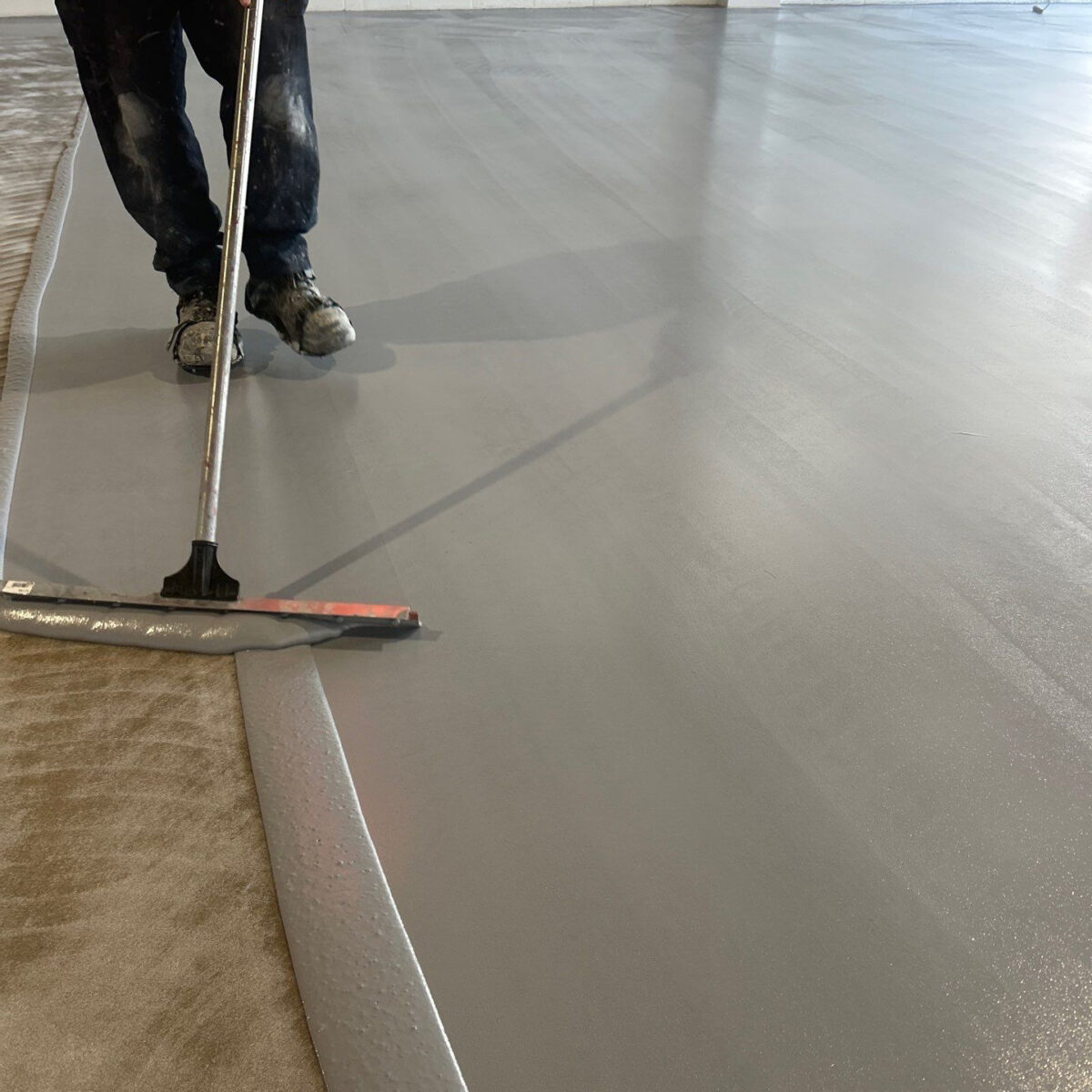
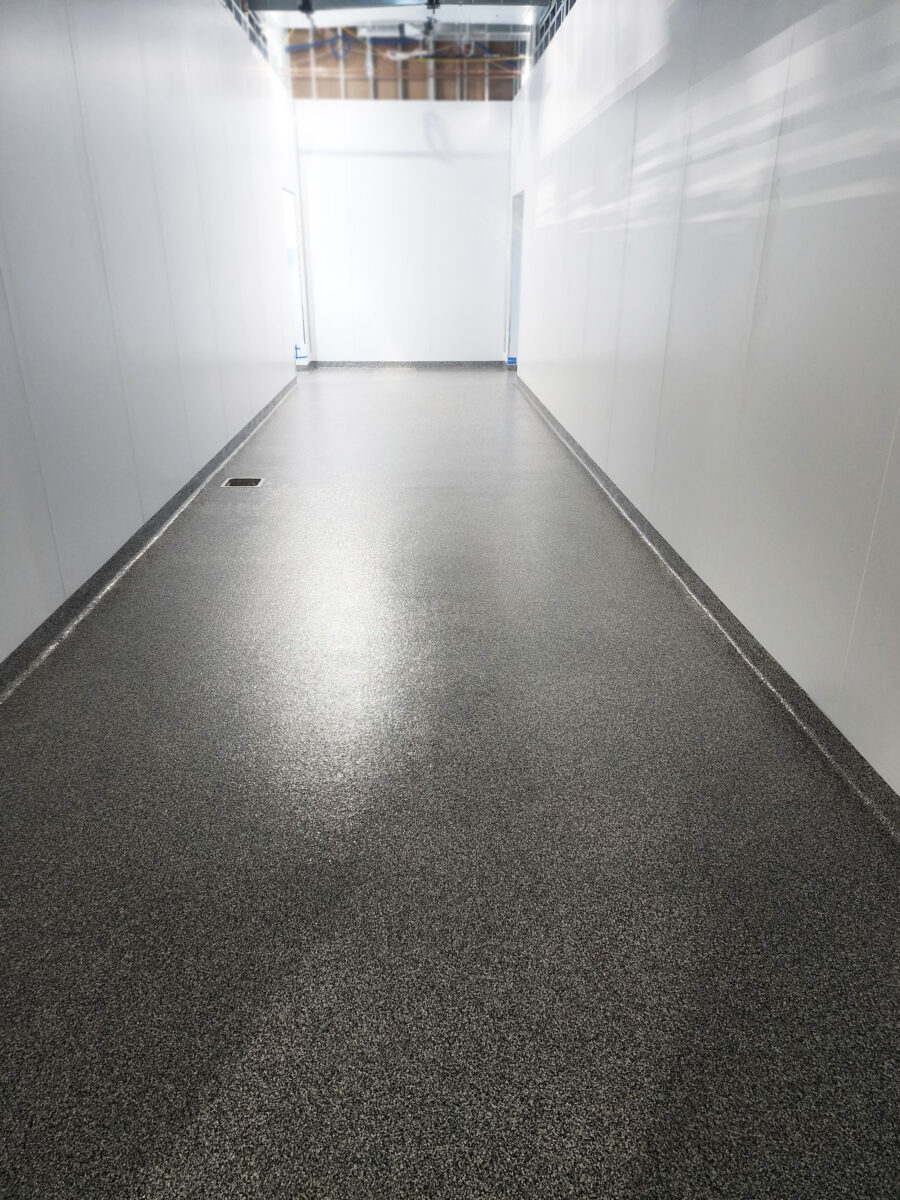
ESD epoxy flooring is a resin-based system installed over prepared concrete. Conductive elements are integrated into the epoxy matrix, allowing static charges to travel through the coating and into a grounding network. The seamless surface reduces contamination points and improves abrasion resistance. The thickness can also be customized to handle heavy-duty industrial demands.
Urethane ESD Systems
Urethane-based ESD flooring provides superior flexibility and impact resistance. It’s often specified for environments subject to thermal cycling, vibration, or heavy mechanical loads. Certain formulations can also handle higher concrete moisture levels.
ESD Tile Flooring
ESD tiles are often made from vinyl or composite materials. Individual tiles are installed with conductive adhesive and connected to ground through copper strips or grounding points. This modular construction allows for faster installation and ease of repair, but it’s only suitable for light-to-moderate traffic zones.
Conductive Rubber Flooring
This static control flooring option provides improved comfort underfoot, making it suitable for areas where employees stand for extended periods. Rubber flooring resists wear from foot traffic and light carts, but it’s not intended to withstand vehicle traffic.
Testing Protocols
Testing before and after installation confirms that your ESD floor meets the required resistance range and provides consistent static control.
Surface Resistance Testing
This test measures electrical resistance point-to-point across the floor. Specialized meters apply a known voltage and record the resulting resistance value. Regular surface resistance testing is recommended to confirm the following:
- The flooring material falls within the specified conductive or dissipative range.
- No isolated high-resistance areas are present.
- Traffic patterns have not altered performance.
Resistance-to-Ground Testing
This test evaluates how effectively static charges travel from the floor surface through the system to an approved grounding point. The purpose is to verify the following:
- Copper strips are properly embedded and connected.
- Grounding points are secure and continuous.
- The building ground is integrated into the ESD flooring system.
Charge Decay Testing
This test measures how quickly a material dissipates an applied static charge. Faster decay times generally indicate better static control performance. Charge decay testing is particularly relevant in robotics and electronics manufacturing, where rapid movement and automated processes are known to generate static events.
Installing a Complete ESD-Controlled Flooring System
Successful ESD flooring installation requires this multi-step approach:
- Material selection: ESD flooring provides the controlled resistance needed to dissipate static. The material you select should match your operating conditions. Since low humidity increases static buildup, the specification should also account for the lowest expected relative humidity in the installation location.
- Concrete preparation: Your installer will mechanically prepare the slab to ensure proper adhesion. Moisture levels are tested during this step to confirm compatibility with the selected ESD flooring system.
- Copper grounding grid: Conductive copper strips are installed beneath the flooring material to collect static charges from the surface.
- Ground connections: Copper strips are connected to a building ground or grounding bus. Testing at this stage ensures that static charges are being discharged safely.
- Conductive primer or base coat: In many ESD flooring systems, a conductive primer or intermediate layer is applied to enhance electrical performance and bond strength.
- Adhesive selection for tile systems: ESD tile flooring requires a special conductive adhesive to ensure electrical continuity between the tiles and the grounding grid.
- Environmental control: With resinous epoxy or urethane systems, temperature and humidity must be closely monitored to ensure proper curing.
- Post-installation testing: Resistance and grounding tests are conducted before the area is deemed safe for production use.
Following ESD flooring installation, your focus should shift to personnel grounding. Conductive and dissipative flooring work best when paired with ESD footwear or heel straps. Employees become part of the grounding system as static charges dissipate through their shoes and into the floor. Wrist straps, grounded mats, ionizers, and properly grounded equipment also complement the ESD-controlled flooring system. Together, these elements complete the installation to protect sensitive electronics and robotics at every stage of production.
Maintenance Requirements
Long-term physical integrity and conductive or dissipative performance depend on how well you take care of your floors. Recommended maintenance practices include:
- Routine cleaning: Only use manufacturer-approved cleaners. Avoid waxes or coatings that may interfere with conductivity.
- Scheduled testing: Perform periodic surface and resistance-to-ground tests to confirm continued compliance.
- Damage repair: Address gouges, cracks, or tile failures promptly.
- Humidity control: Maintain environmental conditions that align with your original ESD specification.
- Consistently enforced footwear policy: Ensure employees wear approved ESD shoes or grounding straps in designated areas to maintain system effectiveness.
Strengthen Static Control in Your Facility
Static control is a foundational part of electronics and robotics manufacturing in 2026. Selecting the right ESD conductive flooring, installing it correctly, and maintaining it properly determines how well that protection performs on your production floor.
For over 20 years, MSC Floors has transformed concrete surfaces with coatings that enhance appearance, safety, and static control in manufacturing facilities. Our project managers work hard to keep every job clean and organized from beginning to end. Contact us today to schedule ESD flooring installation in Michigan, Ohio, or Northern Indiana.
FAQs
Can an existing concrete floor be upgraded to an ESD floor?
Yes, many existing slabs can be converted to an ESD conductive flooring system. Your installer will assess moisture levels, surface condition, and structural integrity before recommending an appropriate solution.
Does ESD tile flooring perform as well as resinous systems?
ESD tile flooring can meet the same required resistance ranges as resinous systems. The main differences relate to durability and construction. Tile systems have seams and don’t handle heavy traffic or aggressive cleaning as well as seamless ESD epoxy flooring. The right choice depends on how your space is used, not just the conductivity rating you require.
What causes an ESD floor to lose conductivity?
Loss of conductivity can result from improper cleaning products that leave insulating residues, physical damage that interrupts the conductive pathway, or failed grounding connections. Following approved cleaning procedures, enforcing footwear policies, and protecting the surface from excessive impact or gouging helps preserve long-term electrical performance.
What happens if part of the grounding system fails?
If a grounding connection is compromised, sections of the floor may fall outside specified resistance ranges. Routine testing is the best way to identify issues so repairs can be made promptly.
How often should an ESD floor be tested?
Many facilities conduct quarterly tests. However, monthly testing is common in high-sensitivity electronics or robotics environments. At the very least, resistance and ground testing should be conducted annually, as well as after any repairs or modifications to grounding connections.