Industrial Flooring for Food Plants: USDA Compliance Checklist
June 8, 2026
The Role of Industrial Flooring in Sustainable Manufacturing
June 22, 2026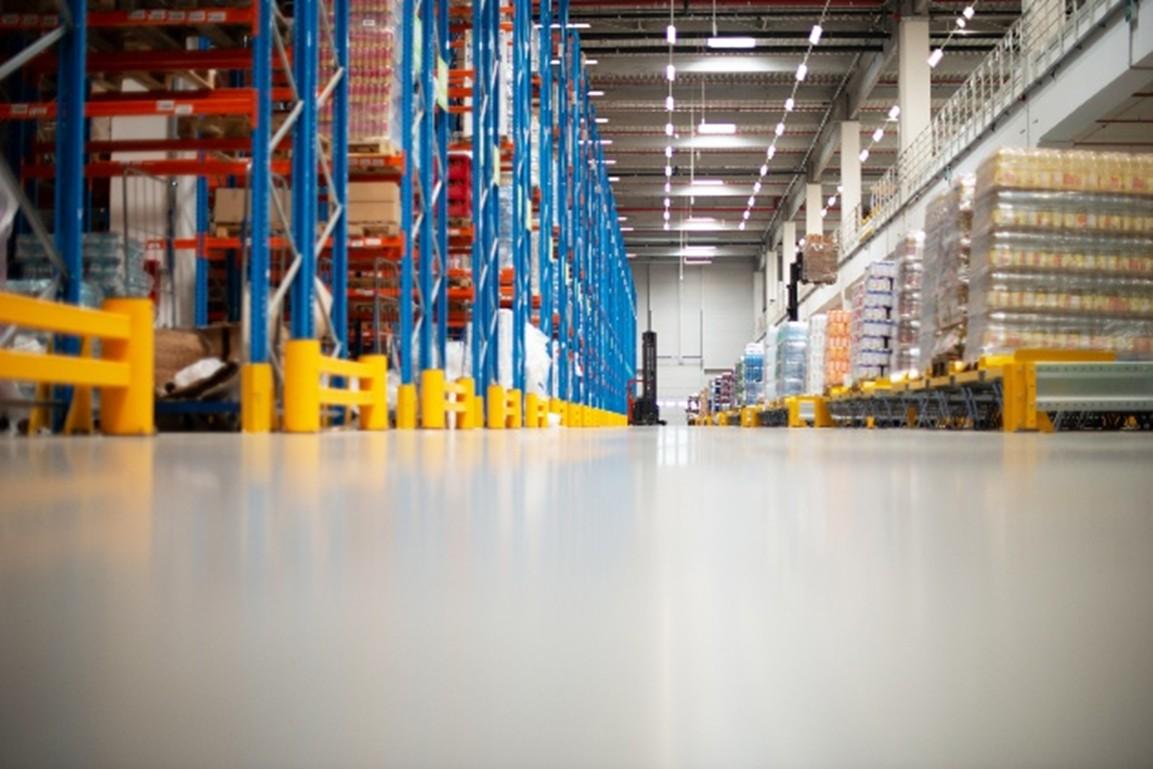
AGVs & Industrial Flooring Requirements
Automation is increasingly becoming the norm in warehouses and manufacturing facilities. Autonomous guided vehicles (AGVs) and autonomous mobile robots (AMRs) are now the preferred way to move pallets, stage inventory, and replenish production lines. They move at impressive speeds with consistent accuracy and can work around the clock.
Industry research shows that the global warehouse robotics market is projected to grow from $9 billion in 2025 to over $24 billion by 2031 as companies seek faster throughput and lower labor costs. Other reports estimate that automation can reduce labor expenses by 25% to 30% while increasing order fulfillment speeds by 300% and boosting accuracy to nearly 99%.
If you’re ready to embrace automation at your facility, there’s one important aspect you can’t overlook: the floor.
The Rise of Automation: Why Flooring Must Adapt
AGVs and AMRs operate differently than human-operated forklifts and pallet jacks. Traditional material handling can tolerate minor dips or uneven wear because human operators adjust instinctively. Robots do not.
Modern automated material handling systems rely on sensors, cameras, lasers, QR codes, magnetic strips, or SLAM (simultaneous localization and mapping) technologies. These systems can only operate correctly if the floor conditions match their programmed assumptions. Surface variations may disrupt sensor readings or interfere with wheel tracking, forcing the automation platform to compensate by slowing down, making course corrections, or triggering error stops.
If your facility is expanding or retrofitting an existing space, don’t let the flooring become an afterthought. Reworking after problems emerge costs far more than designing the coating system correctly from the start.
Planning Your Automated Warehouse Flooring Upgrade
A successful flooring strategy starts with a clear understanding of how your automation equipment interacts with the coating system. Below are the AGV flooring requirements every facility should review when planning a flooring upgrade.
Load Considerations
AGVs place different stresses on your floor than human-driven forklifts. After all, these vehicles carry consistent payloads along predefined paths. This predictability improves efficiency, but it also creates concentrated, repetitive point loads in the same narrow wheel paths day after day.
The areas directly beneath the wheels experience the highest stress from both static and dynamic loads. Static loads include parked robots and stored materials. Dynamic loads occur during acceleration, deceleration, and turning. Your floor must be engineered to handle both, knowing that concentrated wheel pressures can reach hundreds or even thousands of pounds per square inch.
When evaluating load capacity, your installer will assess the following to determine whether the slab can withstand concentrated wheel loads:
- The compressive strength of the concrete
- Slab thickness and reinforcement
- Joint spacing and condition
If your existing slab was designed primarily for manual forklifts, it may not account for the concentrated, repetitive loading patterns created by AGVs. Joint repair, slab stabilization, or surface reinforcement in high-traffic lanes may be required to meet updated AGV flooring requirements.
Abrasion-Resistant Performance
AGVs that repeatedly travel the same lanes do more than put static and dynamic loads on the concrete slab. They also create abrasion on the floor coating surface. Abrasion resistance is essential for maintaining consistent traction, preventing dust, and preserving surface reflectivity.
Low abrasion performance may cause coatings to wear thin along travel routes, exposing the concrete substrate and creating uneven traction. To prevent these issues, reinforcement along high-traffic wheel paths is often recommended. This may include thicker coatings, higher-performance epoxy or urethane topcoats, or densified polished concrete designed for heavy mechanical wear.
Surface Smoothness Requirements
Surface smoothness and flatness are among the most critical factors for automated warehouse flooring. Even small variations in elevation can trigger sensor misreads, cause unnecessary speed reductions, or accelerate wheel wear.
High-performance flooring for automated material handling adheres to tighter levelness tolerances than standard warehouse slabs. Facilities with high-speed AGVs or narrow-aisle robotic systems often require super-flat floors down to millimeter accuracy to ensure predictable travel paths.
Polished concrete and high-build epoxy coatings are excellent at improving surface uniformity. Precision grinding and joint repair eliminate elevation differences that can throw off vision-based and laser-guided navigation systems that rely on consistent geometry to function correctly. A thorough floor survey is the best way to identify problem areas before they interfere with production.
Reflectivity and Color Considerations
Vision-based AGVs and AMRs rely on cameras to interpret their surroundings, so lighting and visual contrast are important considerations. Highly reflective surfaces may cause glare under intense LED lighting, which can affect QR code readability, line-following systems, obstacle detection, and mapping accuracy. Dark, low-contrast floors present a different set of challenges caused by reduced edge detection.
In most automation environments, the best option is somewhere in between. A light-colored floor with a low- to medium-gloss finish offers the right balance of visibility and contrast without creating glare. Strategic color zoning also keeps traffic moving safely. Clearly marked robot lanes, pedestrian walkways, and staging areas make it easier for automated systems to operate alongside forklifts and foot traffic.
An experienced robotics-compatible flooring contractor can work directly with your automation integrator to make sure color, gloss level, striping, and surface finish all align with your system’s navigation requirements.
Impact Durability Standards
Robots may be precise, but warehouses are still busy, fast-moving spaces. Pallet transfers, shifting loads, and accidental bumps are part of daily operations. That’s why your flooring must be able to handle dropped pallets, conveyor transfers, and contact from pallet movers or forklifts.
High-build epoxy systems, urethane cement coatings, and consistent maintenance go a long way toward preventing surface cracks, coating separation, and joint edge breakdown caused by repeated impacts. Staying on top of floor repairs and upkeep helps protect your operations and keeps traffic moving smoothly.
If your facility uses a mix of robots and manual equipment, impact durability matters even more. The floor must stand up to steady, programmed robotic movement as well as the occasional hard stop or sharp turn from human-operated machinery. In transfer zones where loads move from automated conveyors to floor-based robots, extra reinforcement is often a smart move to prevent premature wear.
Long-Term Maintenance Planning
In a robotics-heavy environment, minor surface defects can ripple through your entire operation. A proactive maintenance plan helps prevent avoidable slowdowns. Here’s what your checklist should include:
- Wheel path inspections: Regularly review high-traffic robot lanes for rutting or coating breakdown.
- Joint monitoring and repair: Address joint spalling and edge deterioration early to prevent rough transitions that can disrupt navigation.
- Targeted recoating: Reapply protective coatings in high-use lanes to extend the life of your automated warehouse flooring.
- Residue management: Clean frequently to limit buildup from oils, packaging debris, and other contaminants that may interfere with traction or sensor accuracy.
- Surface damage response: Establish a protocol for quickly repairing chips, cracks, or impact damage so small defects don’t grow into larger structural problems. Planned shutdowns are a great opportunity to touch up high-traffic areas or conduct joint repairs.
Partner with Us for Your Automation-Ready Floor Upgrade
When automation changes the way your facility operates, your flooring must keep pace. MSC Floors has over 20 years of experience transforming concrete surfaces for demanding industrial environments. Our team has an in-depth understanding of AGV flooring requirements, allowing us to recommend world-class flooring solutions that help your automated warehouse perform at peak efficiency. Contact us today to schedule a free site survey and discuss how we can design a flooring solution to meet your facility’s needs.
FAQs
How do I know if my existing floor is suitable for AGVs?
A professional site survey is a good starting point. A robotics-compatible flooring installer will check for flatness, joint condition, compressive strength, and surface wear. The findings will reveal whether repairs, precision grinding, or an entirely new coating system is needed.
Can coatings fix an uneven slab?
Coatings improve surface uniformity, but they can’t correct major structural issues. Grinding, joint repair, or slab remediation may be necessary before installing flooring for automated material handling. Your installer will recommend the appropriate preparation steps.
Will automation increase my floor maintenance costs?
Maintenance needs shift, but they don’t automatically go up. Automated systems create concentrated wear in specific lanes, so most of your attention shifts to high-traffic wheel paths instead of the entire floor. With AGV flooring requirements in mind at installation and a solid maintenance plan going forward, long-term upkeep is often easier to predict than in non-automated warehouses.
What type of flooring is best for mixed environments with robots and forklifts?
High-performance epoxy or urethane systems, as well as polished concrete designed for heavy traffic, are common choices. The right solution depends largely on load demands and chemical exposure. A site survey by an industrial flooring professional ensures your automated warehouse flooring meets the needs of both robotic and manual equipment.
What signs indicate that my flooring is affecting AGV performance?
Watch out for frequent recalibration, unexpected slowdowns, excessive wheel wear, or recurring error stops along specific routes. The best way to restore efficiency is to schedule a site assessment. A flooring professional can determine whether surface wear, rutting, or joint damage is contributing to the problem.